


 |
Product Description:
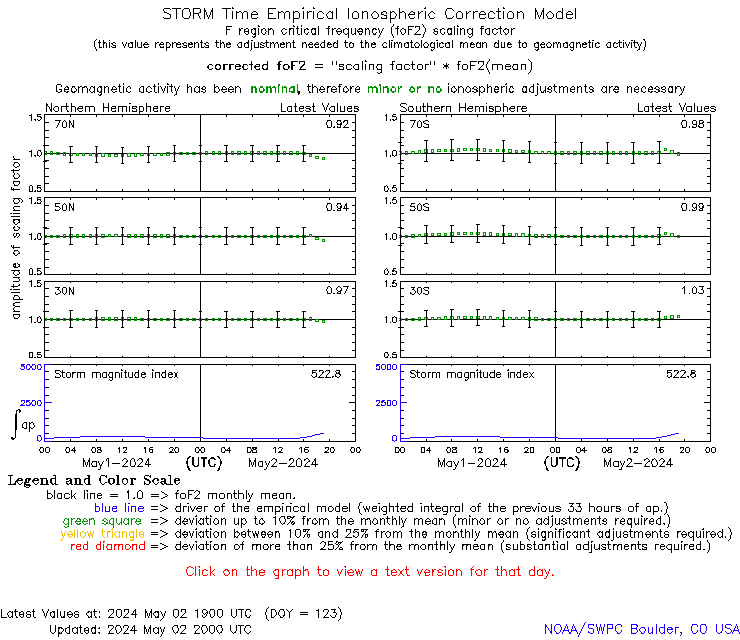
The STORM model provides an estimate of the expected change in the ionosphere during periods of
increased geomagnetic activity. The model estimates the departure from normal of the F-region critical
frequency (foF2) every hour of the day for the current and previous day. The STORM model was developed
from ionospheric observations during many storms that were analyzed as a function of season and latitude.
Target Users:The storm-time correction of the F-region critical frequency is primarily of benefit for high frequency (HF; 3-30 MHz) communication users. |
R1 (Minor) Radio Blackout Impacts

HF Radio: Weak or minor degradation of HF radio communication on sunlit side, occasional loss of radio contact.
Navigation: Low-frequency navigation signals degraded for brief intervals.
More about the NOAA Space Weather Scales
Navigation: Low-frequency navigation signals degraded for brief intervals.